
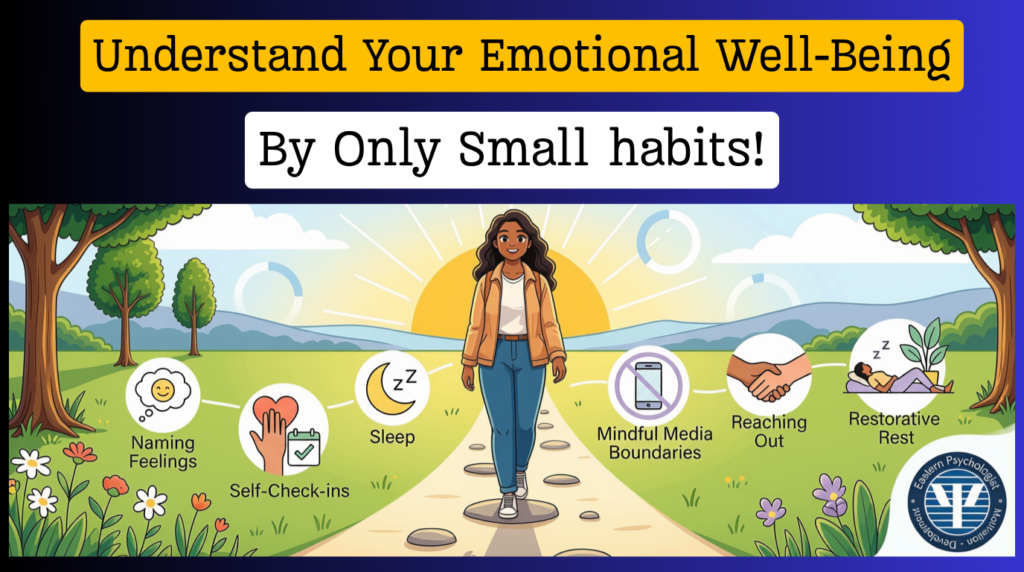
Emotional well-being is often described as a finish line, something a person either reaches or does not. A calm, settled state that some fortunate people have figured out. In reality, this is not how it works. Emotional well-being behaves more like fitness than like an achievement. It is something built through repetition, something that grows stronger with practice and can weaken if left untended. Some days will still be harder than others, no matter how many good habits a person has. This is normal. What changes with practice is how quickly a person recovers.
What Emotional Well-Being Actually Means
Here is a distinction worth sitting with: emotional well-being is not the absence of difficult feelings. Sadness, frustration, anxiety, and grief are not malfunctions. They are part of being a person with a nervous system, and trying to push past them by force usually backfires. Psychologists tend to describe emotional well-being less as a feeling and more as a set of abilities:
- Noticing and naming what one is feeling, instead of sitting in a vague sense of being “off”
- Keeping emotional intensity at a level where it does not take over one’s ability to function
- Recovering from difficult experiences within a reasonable amount of time, rather than staying stuck
- Holding on to some sense of meaning and connection, even when circumstances are genuinely difficult
Why does this framing matter? Because it changes what a person is actually working toward. The goal is not a permanent good mood. The goal is building the capacity to feel the full range of what life brings, without being overwhelmed by it.
Why Small Habits Beat Big Gestures
There is a common assumption that real change requires something dramatic: a new job, a significant trip, or a complete overhaul of one’s routine. Research on habit formation and stress response points in the opposite direction. Small actions, repeated consistently, tend to outperform occasional large efforts, largely because consistency compounds in a way that intensity does not.
Consider exercise as an example. A five minute walk taken almost every day will do more for a person’s mood over six months than a single intense workout completed once and never repeated. The same logic applies to emotional habits.
Habits Worth Building
1. Name the Feeling Before Reacting to It
There is usually a small gap, easy to miss, between an emotional spike and having the words to describe what has happened. If a person can notice that gap and name what they are feeling, even silently (“I am frustrated,” “I feel dismissed,” “I am anxious about this”), a different part of the brain becomes engaged than if the person simply reacts. A UCLA neuroimaging study supports this: labeling an emotion measurably reduces activity in the amygdala, the brain’s alarm system, while increasing activity in a region associated with cognitive control (Lieberman et al., 2007). This is not about suppressing the feeling. It is about creating a moment of clarity before deciding how to respond.
2. Check In With Yourself, Briefly
This habit does not require a journaling practice or a meditation app. Spending two or three minutes a day honestly asking “how am I actually doing right now?” can prevent small stresses from quietly accumulating into something larger. A commute, a short walk, or the few minutes before falling asleep are all suitable moments for this.
3. Treat Sleep as Non-Negotiable
Sleep and emotional regulation are more closely linked than most people realize. The effect is not limited to feeling tired and short tempered after a poor night’s sleep. A University of California, Berkeley study using brain imaging found that sleep deprived participants showed a stronger amygdala response to negative images, along with weaker connectivity to the prefrontal cortex, the region of the brain that normally keeps emotional reactions in check (Yoo et al., 2007). In practical terms, insufficient sleep measurably reduces a person’s ability to manage frustration and mood swings the following day. Protecting one’s sleep schedule deserves to be treated as a form of emotional self care, not only a physical health habit.
4. Set Limits on Doom Scrolling
Constant exposure to distressing news, or to the comparison inherent in social media, keeps the nervous system in a state of low level alert. It is not necessary to give up either one entirely. Setting boundaries, such as specific windows of time for checking the news or scrolling, rather than leaving it open ended, tends to reduce this background stress considerably.
5. Reach Out Before It Feels Necessary
Most people wait until they are already overwhelmed before speaking to someone. A better habit is checking in with a trusted friend, family member, or professional on a regular basis, not only during a crisis. This way, a support system is already in place by the time it is actually needed.
6. Allow Rest Without Requiring It Be Earned
In many cultures, including much of South Asia, rest can feel like something that must be earned through exhaustion, a reward for having worked hard enough. Shifting this framing, so that rest is treated as basic maintenance rather than a prize, tends to make emotional health considerably more sustainable over time.
When Habits Are Not Enough
None of this is meant to suggest that habits alone can resolve every difficulty. For someone dealing with persistent low mood, anxiety that interferes with daily functioning, or the aftermath of trauma, these habits function as support rather than a substitute for professional help. The two are not in competition with one another. Habits provide day to day stability, while therapy addresses the deeper patterns underneath. They tend to work best when combined, rather than treated as alternatives.
A Realistic Starting Point
It may be tempting to adopt all six of these habits at once. This is not advisable. Choosing one, or perhaps two, and maintaining them for a few weeks before adding anything further tends to produce results that last considerably longer than an overnight overhaul. This reflects something true about resilience itself: it is not built through a single decision. It is built the way most worthwhile things are built, through repetition, over time.
This article is for informational and educational purposes and is not a substitute for professional mental health advice, diagnosis, or treatment. If you are struggling with your mental health, consider speaking with a qualified mental health professional.
References
Lieberman, M. D., Eisenberger, N. I., Crockett, M. J., Tom, S. M., Pfeifer, J. H., & Way, B. M. (2007). Putting feelings into words: Affect labeling disrupts amygdala activity in response to affective stimuli. Psychological Science, 18(5), 421-428. https://doi.org/10.1111/j.1467-9280.2007.01916.x
Yoo, S. S., Gujar, N., Hu, P., Jolesz, F. A., & Walker, M. P. (2007). The human emotional brain without sleep, a prefrontal amygdala disconnect. Current Biology, 17(20), R877-R878. https://doi.org/10.1016/j.cub.2007.08.007