
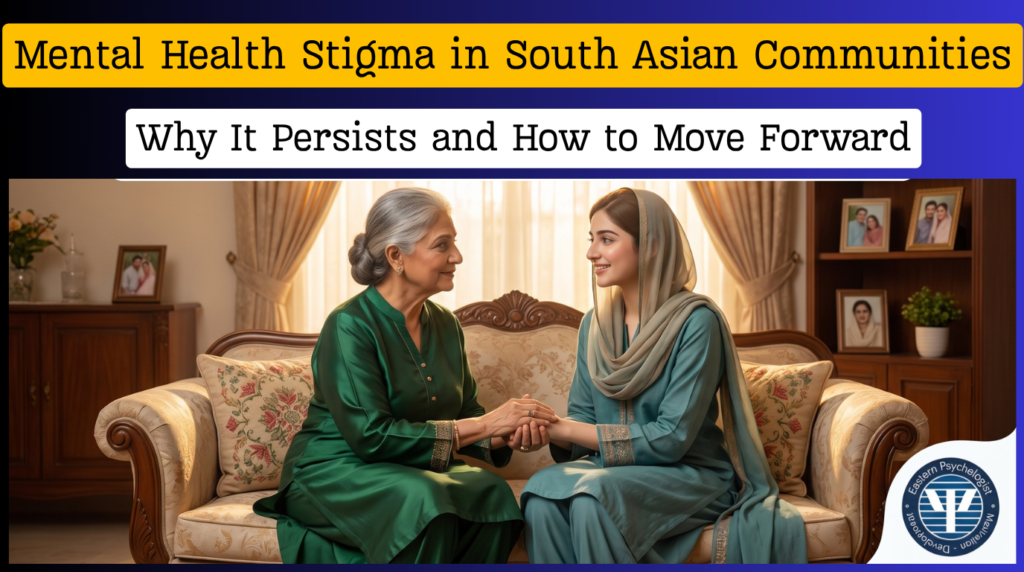
Mental Health Stigma in South Asian Communities: Why It Persists and How to Move Forward
Mental health stigma is not unique to any single culture, but the way it shows itself, and the barriers it creates, can look quite different depending on cultural context. Within South Asian communities, including Pakistan and South Asian diaspora populations abroad, research consistently points to stigma as one of the strongest barriers preventing people from seeking help for depression, anxiety, and other common mental health conditions. Understanding why this stigma persists, rather than simply naming it as a problem, is an important first step toward addressing it.
How South Asian Communities Often Understand Mental Distress
A large systematic review of research on South Asians living in high income countries found that mental distress is frequently understood through a psychosocial or religious lens rather than a biological one (Jain et al., 2025). Rather than attributing depression or anxiety to brain chemistry, many individuals and families instead point to situational causes, such as family conflict, life stressors, or personal weakness of character. In some cases, spiritual explanations are also common, including beliefs about supernatural causes.
This is not a matter of ignorance. It reflects a genuinely different framework for understanding illness, one that has its own internal logic and cultural history. However, the same review found that this framework is closely tied to how much stigma a person experiences, since problems seen as arising from personal or moral weakness tend to be judged more harshly than problems understood as biological or medical in nature.
Two Types of Stigma at Work
Researchers commonly distinguish between two related but distinct forms of stigma:
- Public stigma, meaning the prejudice and discrimination directed at a group by the wider community
- Self-stigma, meaning what happens when an individual internalizes those public attitudes and begins to apply them to themselves
Both forms were found to play a significant role in the South Asian communities studied. Public stigma often centers on fear of being labeled “weak” or “crazy,” while self-stigma frequently shows up as shame, a desire for isolation, and reluctance to be a burden on the family (Jain et al., 2025). Importantly, these two forms of stigma tend to reinforce one another. A person who fears public judgment often begins avoiding the topic altogether, which then deepens the private sense of shame.
Family: A Source of Both Support and Pressure
One of the most consistent findings in this area of research is that family occupies a complicated position. For many individuals, family is described as a primary source of comfort and support during difficult times. For others, family relationships are described as a direct cause of psychological distress, and a reason not to seek outside help.
This tension often becomes most visible across generations. Younger, second generation individuals are frequently more comfortable using clinical terms such as “depression” or “anxiety,” having grown up with greater exposure to Western mental health concepts. Older generations may be less familiar with these terms and, in some cases, more likely to view mental health conditions as personal failings that could bring shame to the family’s reputation (Jain et al., 2025). A related study examining South Asian communities in the United Kingdom found that this generational divide is one of the clearest and most consistent factors shaping whether someone feels able to seek professional support, with second generation individuals generally more willing to use mental health services than the first generation (Shukla, 2023).
None of this means one generation is right and the other is wrong. It means that conversations about mental health within families may need to bridge two genuinely different frameworks for understanding the same experience.
Why People Often Cope Privately Instead of Seeking Help
Given these pressures, it becomes easier to understand why private coping strategies, such as prayer, distraction, keeping busy, or simply enduring difficulty alone, are so common. These strategies allow a person to manage distress without exposing themselves or their family to potential judgment. Research describes this pattern as understandable given the social risks involved, even though private coping alone is often insufficient for more serious or persistent mental health conditions (Jain et al., 2025).
This points to an important distinction. Choosing to cope privately is not a personal failure. It is frequently a rational response to a genuine social risk. The goal of reducing stigma, then, is not to criticize how people have coped in the past. It is to reduce the risk itself, so that seeking professional support becomes a safer and more viable option alongside these existing coping strategies, rather than a replacement that requires abandoning them entirely.
What Actually Helps
Encouragingly, research also points to specific approaches that appear to reduce stigma and improve outcomes:
- Community based, culturally informed education, rather than generic public health messaging, appears more effective at shifting attitudes
- Involving family in the conversation, rather than treating mental health as an individual matter alone, tends to align better with collectivist cultural values
- Contact based approaches, where people hear directly from others who have faced similar struggles, have shown promise in reducing stigma in South Asian communities specifically (Jain et al., 2025)
A Note on Language
One small but meaningful step, both for families and for content like this, is simply having accurate language available. Some South Asian languages do not have a direct, widely used translation for terms such as “anxiety,” which can make it genuinely harder to name and discuss what a person is experiencing. Encouraging the use of plain, descriptive language, such as “feeling constantly on edge” or “unable to stop worrying,” alongside clinical terms, can make these conversations more accessible across generations and comfort levels.
Where This Leaves Us
Mental health stigma in South Asian communities is not a simple problem with a single fix. It is shaped by genuine cultural frameworks, real family dynamics, and legitimate concerns about social consequences. Recognizing this complexity, rather than treating stigma as simple ignorance to be corrected, is what allows for a more compassionate and more effective approach, whether that approach comes from families, communities, or mental health professionals working to build trust with the people they hope to help.
This article is for informational and educational purposes and is not a substitute for professional mental health advice, diagnosis, or treatment. If you are struggling with your mental health, consider speaking with a qualified mental health professional.
References
Jain, R., Kakuma, R., Singla, D. R., Andresen, K., Bahkali, K., & Nadkarni, A. (2025). Explanatory models of common mental disorders among South Asians in high-income countries: A systematic review. Transcultural Psychiatry, 62(2). https://doi.org/10.1177/13634615241296302
Shukla, J. (2023). The stigma of mental healthcare: A qualitative analysis of the utilisation of mental health services by South Asians in the UK. European Psychiatry, 66(S1), S819. https://doi.org/10.1192/j.eurpsy.2023.1735
Pingback: Depression Worksheet PDF: Free Reflection & Check-In Tool